From the start, Enterprise
20/20 was envisioned as a social endeavor; an initiative that would be
shaped by its contributors in sometimes unexpected ways. Just three months into
this project, crowd-sourcing is underway in many conversations across the site.
One topic in particular has prompted several dozen active contributors to
comment again and again in a thread that has been read close to 2,000 times.
The subject is the future of employees, and the
opinions are varied and impassioned. Thanks to your input, we are going to add
Employee 20/20 to the lineup of ebook chapters that will go live before HP Discover 2012 in
December. (The previously scheduled Boardroom 20/20 chapter will be published
in 2013 – when we plan to publish version 2.0 of the ebook at Discover Las
Vegas – so get in your nominations now!)
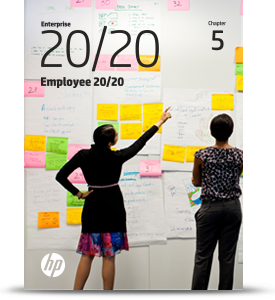
This is crowd-sourcing at its best, and we are delighted
by the way in which our community members have engaged around a topic that we
didn’t make a top priority at the outset.
Along the way, two questions have come up:
·
How will we handle attributions when we weave community
member perspectives into the ebook?
When
we reference community member comments, we will link to specific threads in the
Discussion Hub so readers can
see comments in the context in which they were shared. We may also quote some
contributors as sources in the chapters, when their comments support or refute
a point we’d like to make. In these cases, we may reach out to community
members to ask permission to share their names and titles, in addition to their
usernames.
·
When will we update chapters to reflect community input?
The answer here depends on the level of activity in the community around the
chapter topic. We monitor the Enterprise 20/20 discussion hub daily and plan to
revisit the chapters to make updates closer to HP
Discover Frankfurt, which takes place December 4-7, 2012.
Now that we’ve made the decision to proceed with
Employee 20/20, we need your help. Please join us in taking the next step to define what this new
chapter should cover and what it should look like. What hot button issues will
shape what it means to be an employee in 2020? For example, we might organize
our thoughts around some of these categories, or perhaps we should consider
other categories not yet on the list:
-
Employment. What does working for someone/something
else look like or mean in 2020? How will benefits like health insurance and
401K plans change? Will the balance of power be with employees for whom company
loyalty means nothing, or will we want to once again work for one company
forever? What does the Employee Handbook of 2020 look like? Will unions exist?
Will workloads be lighter or heavier? How about pay scales?
-
Location. Where will we work in 2020? At home? At
Starbucks? Commuting to the office where we sit in glass-enclosed cubicles?
Will we be able to work virtually anywhere in 2020, or will we still be
somewhat tethered? What technologies will enable this change? Will a workday
begin in the morning and end at 6 p.m., or will we all be able to work in
spurts that are interrupted by attending our kids’ ball games in the middle of
the day?
-
Tools. Today it’s common that your tools at work include a
phone, a computer/laptop, printers, copiers, network access, and a cell phone.
How will that toolbox change in 2020? What will be the productivity tool
of choice and what does this mean for IT? How will printing change—we all
thought we’d have a "paperless office” by now. Will that be a reality in 2020?
How will documents move from device to device? How will our communication be
enabled? Will we still have whiteboards? Virtual rooms? Bridge lines? What will
the collaborative canvas of 2020 look like?
-
Organizations. Will hierarchies disappear in 2020? Or will
we be so choked by consensus-building that we crave levels of authority? What
new organizational models will emerge?
-
The boss. How will the relationship between managers
and employees change by 2020? What new leadership models might emerge? How will
our performance be measured?
We’d like to know what you think. We’re also interested
in your graphics, videos, infographics, research, blog topics and even cover
art. Let’s continue the conversation, and in a couple of weeks, we’ll distill
the feedback into an outline for the chapter.